Let’s bring the salmon and sea birds back!
The hypothesis on overgrazing and predation
Is overgrazing and predation by mackerel to blame
for declining European salmon and sea bird stocks today?
Jens Christian Holst
jens@ecosystembased.com
June 2018
Background
Wild salmon stocks from in particular the European southern NEAC salmon area are dwindling and today for instance most Irish and Northern Irish rivers are closed for ‘normal’ fishing. Hypotheses on the marine factors underlying the salmon collapse are many: marine climate, sea lice from salmon farms, inbreeding of escapees in wild salmon stocks and bycatch in pelagic fisheries.
The ICES Working Group on North Atlantic Salmon, WGNAS, is clear in its conclusions: ‘The continued low abundance of salmon stocks in many parts of the North Atlantic, despite significant fishery reductions, strengthens the view that factors acting on survival in the first and second years at sea are constraining the abundance of Atlantic salmon.’
As a marine fisheries scientist, I have worked closely on the marine ecology of salmon and the factors affecting marine survival of Atlantic salmon since 1991. Based on my ecosystem-based research in the NE Atlantic, I have developed the hypothesis that overgrazing and predation are major factors behind dwindling salmon and sea bird stocks of western Europe.
Based on what I consider to be strong empiric evidence, the NE Atlantic mackerel stock has grown totally out of proportion due to gross underestimation, leading to overly cautious fishing quotas and underfishing as a consequence. Because of this very large mackerel stock, the food resources of whales, seals, sea birds, salmon, other pelagic fishes and the mackerel itself are now heavily overgrazed. Today, a 7-year-old mackerel weighs half of its weight of 10 years ago — a clear sign of the overgrazing and lack of food.
This lack of food has also led to starvation and very slow growth of young salmon at sea, the salmon postsmolt. Postsmolts are now more vulnerable to predation and disease than before the mackerel ‘explosion’.
Voracious hunters
A 30 cm long mackerel will eat a 12.5 cm mackerel meaning a mackerel can eat a fish 40% its own length (Figure 1). This again means a mackerel at 50 cm can eat a 20 cm postsmolt salmon. In other words, mackerel today can prey efficiently on postsmolt salmon during much of the postsmolts first summer at sea.
Traditionally, the main spawning grounds of the NE Atlantic mackerel stock were in the North Sea and west of the British Isles. In parallel with the strong stock growth starting around 2003, mackerel spawning areas swelled, particularly in the western areas and northwards. From 2008 onwards, mackerel have also spawned in the Norwegian Sea and in Norwegian fjords, as far north as northern Norway (Figure 2).
The widening of mackerel egg distributions from April-May 1992 (Figure 3 ) to 2016 (Figure 4) demonstrate the increase of the mackerel spawning stock distribution west of the British Isles. In figure 5 and 6 the expansion of the mackerel summer feeding areas during 2007 to 2017 is demonstrated.

Figure 1: 30 cm mackerel with 12.5 cm mackerel in its stomach. Photo courtesy of Ian Kinsey.

Figure 2. Catches of spawning mackerel during the IESNS surveys in the Norwegian Sea May 2008-2016. Spawning mackerel was never observed in this area before 2008 but has intensified strongly after, both in the Norwegian Sea and in Norwegian fjords way north to northern Norway. From ICES WGWIDE 2017.

Figure 3: Distribution of mackerel egg, proxy for spawning mackerel, during the period of the Irish smolt run in 1992. Left 13 April – 5 May, right 16 May-13 June.

Figure 4: Distribution of mackerel egg, proxy for spawning mackerel, during period of the Irish smolt run in 2016. Left 9-30 April, right 1-30 May. Note that the survey does not find the northern zero line of eggs which correspond well with the observations in figure 2.

Figure 5. The geographic expansion of the NE Atlantic mackerel stock as reflected in the ICES IESSNS survey during 2007-2016. During this period the feeding area of the mackerel expanded by a factor of three while den density doubled, indicating a six fold increase in stock size during the period. Figure from Nøttestad and Utne, Naturen nr 6, 2016.

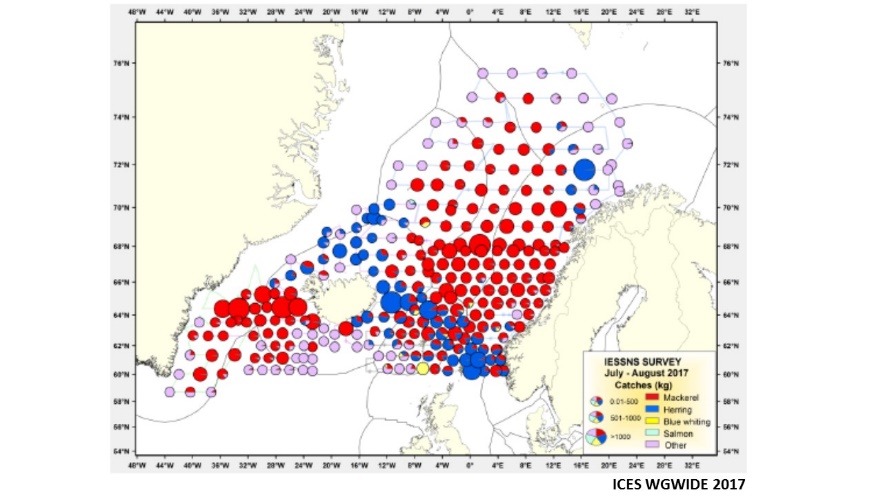
Figure 6. Trawl stations and catches of mackerel in red during the 2017 ICES IESSNS survey. The 2017 survey gave the highest spawning stock biomass index ever at 10.3 million tonnes.
Overlapping migration routes of mackerel and southern postsmolts
Mackerel and southern European salmon postsmolts both use the shelf edge currents west of the European continent to speed up their northern feeding migration in late spring, thus inhabiting the same waters and depths in late spring and summer (Figure 7).

Figure 7. Approximate swimming path of a Corrib postsmolt (red) from western Ireland to its Norwegian Sea feeding area (yellow line). Yellow bubbles are catches of postsmolts made in dedicated salmon trawl hauls during 1991-2011 using the Salmon-Trawl. Note how the postsmolts follow the shelf edge current northwards then spread out in the Norwegian Sea feeding areas, all in parallel with the mackerel as can be seen in the maps above. Original map modified by author.
This ‘co-swimming’ of mackerel and salmon postsmolts during the ‘on average’ about 2,000-kilometre migration from southern European salmon river mouths to north of the Vøring plateau in the Norwegian Sea at 68 degrees north creates the perfect predation opportunity for the starving mackerel on the now slow-growing and vulnerable postsmolts.
Knowing that the migration takes about two months, I leave it to the reader to consider what the effect of the combined effect of competition and predation from mackerel could be on postsmolts from waters off the island of Ireland, France, Spain and western Scotland during this migration period. Mackerel is also abundant in the North Sea and the same situation would apply to postsmolts from Wales, England and eastern Scotland.
The southern salmon stocks have collapsed at much higher and more alarming rates than the Norwegian salmon stocks (Figure 8), despite about 1.3 million tonnes of salmon being farmed in Norway and only 200.000 tonnes being farmed in two of the southern regions, Ireland and western Scotland, plus 500 tonnes in Northern-Ireland. All of the southern postsmolts have to ‘co-swim’ northwards with the now very dense concentrations of mackerel, more than double the distance and period compared with the average Norwegian postsmolt.

Figure 8. Development of salmon nominal catch in southern and northern NEAC 1971 to 2016. Text at top inserted by author.
That said, this is not to defend today’s fish farming practices which I believe are unsustainable and should change to enclosed or semi-enclosed systems — from an environmental perspective and not the least in terms of sustainable growth potential for the industry. Sea lice is a factor for the marine survival of salmon in some areas but it is a relatively small factor today, and should not be the point of focus in the recovery of European salmon stocks.
Following two years of successful mackerel spawning in 2016 and 2017 in the Norwegian Sea and Norwegian coast, these areas are now ’full’ of juvenile mackerel (Figure 9). Consequently, the worst may well be yet to come for the salmon from the southern European salmon regions.

Figure 9. Examples of the young mackerel currently growing up ‘all over’ the North Sea, Norwegian Sea and along the Norwegian coast at the moment. These were caught in a ‘washing set’ by the purse seiner ‘Brennholm’ at an arbitrary position 100 nm west of the Lofoten Isles in January 2018. At this stage these small mackerels are competitors to the postsmolt salmon, later they will be both competitors and potential predators. Photo JC Holst.
The linked sea bird collapse
In parallel with the European salmon collapse, we have witnessed a collapse of a large range of western European sea birds depending on plankton and fish larvae/small fish as main components in their diets. The worst hit species is probably the kittiwake, a small sea gull, which compete directly with the mackerel in its diet.
At the same time we have seen a strong growth in northern gannets populations, a large fish eating sea bird, which have mackerel as an important part of their diet. It seems nesting locations are restricting their population growth in the western Scottish sea bird cliffs while they have expanded strongly for instance in the North Sea on Bass Rock and northwards along the Norwegian Coast and at the Bear Island. The gannet established at the Bear Island few years ago with a 100% nesting success and the colony is growing quickly.
In general sea birds competing with mackerel are plummeting along with the growing mackerel distribution and density while sea bird eating mackerel are thriving from the dramatically increase in availability of mackerel (Figure 10).

Figure 10. The strongly contrasting development in kittiwake and northern gannets on the Runde seabird cliff off the Norwegian west coast at about 62° north is a good example of how the plankton and small-fish eating sea birds lose out in the competition with the mackerel while a mackerel eating sea bird like the gannet prosper from it.
Mackerel, postsmolts and kittiwake have a large overlap in diet, in particular in amphipods, fish larvae and small fishes. The usual explanation for the collapse of the plankton and small fish dependent sea birds is climate change and fisheries. But it is a large paradox that the plankton they eat is not fished and neither are 0-group fish. But they are all prime elements in the mackerel diet.
Reasons unknown
Some scientists claim temperature and climate change is the culprit for the European wild salmon collapse. In my view there is no empiric basis for such a conclusion.
If we study water temperatures in the main feeding area of ‘southern’ European postsmolts in the Norwegian Sea, they rose from the 1970s to 2007 and have now dropped to close to or below normal, according to the Institute of Marine Research (IMR) in Norway. Figure 11 below describes the development in temperature conditions in the most important feeding areas of European postsmolt during the late spring-summer.
Temperatures in the Norwegian Sea follow the so-called Atlantic Multidecadal Oscillation (AMO). This 60-year climate cycle bottomed in the early 1970s, peaked around 2007 and is expected to be negative over the next 20 years from now.

Figure 11. From the Institute of Marine Research report 2017: ‘The Norwegian Sea: The temperatures in the Atlantic water along the Norwegian continental shelf have since 2013 been close to or slightly above normal. The temperatures in 2016 were mainly above normal, except the south-eastern Norwegian Sea were the temperatures were lower than normal.’
Climate change will probably lead to higher temperatures at the peaks and troughs of the coming cycles, but I expect the cycling to continue as documented in sedimentation layers on the seabed since the last ice age of 10,000 years ago.
So, during a period of continuous decline of salmon stocks from in particular the southern European area from around 1973, temperatures in the postsmolt main feeding areas have been rising and peaked in 2007 and have dropped to around normal today.
Consequently, there is no correlation with temperatures and the collapse of the southern European salmon stocks but there is very good correlation with the growing mackerel stock and its potential for competition with and predation on the European postsmolt salmon.
Continuing decline
Despite the AMO having turned negative more than 10 years ago European salmon stocks continue their negative spiral and fishing has almost ceased as the stocks are close to or under conservation limits in particular in the southern NEAC area.
In my view, this situation will probably continue to worsen until the heavy competition and predation by mackerel is reduced. The reduction should be done through an internationally agreed and closely monitored thinning fishery on mackerel, where some of the extra catch goes into meal and oil.
Not to give the pelagic fishermen higher quotas but to bring the ecosystem of the north-eastern Atlantic back within ‘normal’ ranges where both salmon and seabirds dependent on plankton and small fishes will return to sustainable stock levels.
Conclusions
The hypothesis on overgrazing and predation has been hard to sell within the ICES community, in management bodies, with politician and with the wild salmon lobby. The reason for this is most probably because the hypothesis challenges one of the cores of ICES activities, the accuracy of pelagic stock estimation. It also challenges the view that sea lice and escapees are the most serious threats for the wild salmon today. Nevertheless, in search of getting our salmon and sea birds back, every obvious stone must be turned. I have worked with a wide range of mortality factors on wild salmon at sea since 1991, including sea lice, disease and bycatch. It is my strong recommendation that also this hypothesis should be treated and tested seriously. The empiric basis is very much larger than can be shown in this handout.
Very much can also be done about marine bycatch of salmon. I have developed ‘The free passageway model’ which is a model to reduce marine bycatch of postsmolts in the NE Atlantic. The model is ready to go but will need international cooperation to be implemented. And I will be very happy to present both the hypothesis of overgrazing and predation and the free passageway model for interested organisations.
The ocean is something large and unknown for most of the salmon community. I think this is the main reason why most discussions focus around rivers and near shore issues when it comes to understanding and managing the wild salmon. The time is more than ripe for looking out at sea through ecosystembased perspective. I will guarantee all of you a fantastic journey that will give you an entirely new view on why the salmon and sea birds vary in numbers and why they are not as numerous as they used to be. Let’s start today and bring them back home!
So I ask: What is most likely to kill a northward bound 15 cm Corrib postsmolt salmon today —temperatures close to normal or a starving mackerel?
Dr Holst worked as a management scientist on pelagic fish at the Institute of Marine Research in Norway. Today he is an independent fisheries advisor and developer. Several of his publications and talks on salmon at sea and related issues are found by registering and logging into Reseachgate.com.
To stay independent in the controversial field of wild salmon, sea lice, farmed salmon and pelagic fish, he has not taken on projects since 2016 and finances himself today. He is involved in projects on closed contained fish farming.